
INDUSTRYINNOVATIONTECHNOLOGY
M Magnetic Drive vs. Mechanical Seal Chemical Pumps: Which is Right for Your Plant?
In the chemical processing industry, choosing the right pump isn’t just about flow rate—it’s about containment and safety. The two primary contenders for handling hazardous fluids are Magnetic Drive (Mag-Drive) and Mechanical Seal pumps.
What is a Magnetic Drive Pump?
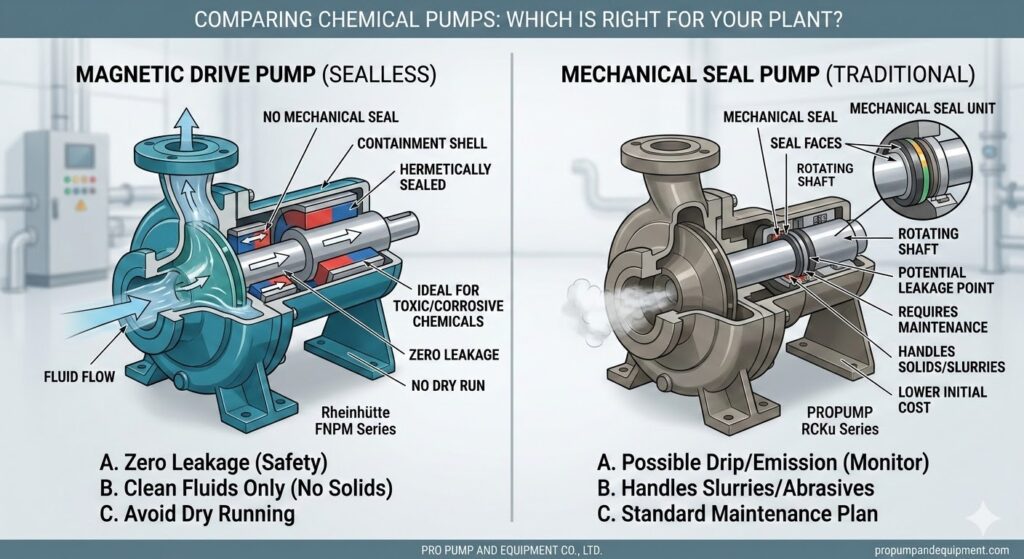
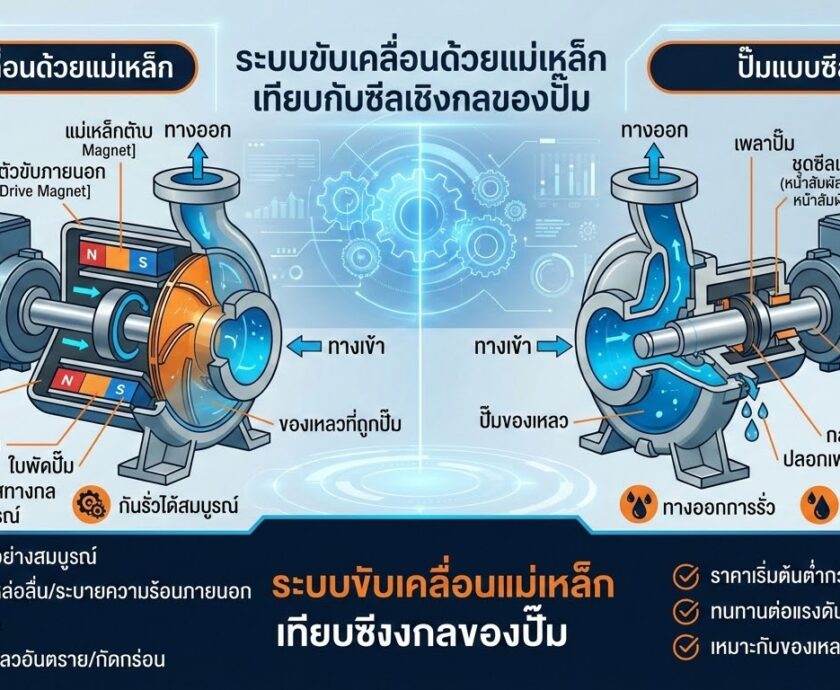
A Mag-Drive pump uses a magnetic coupling to transmit torque from the motor to the impeller. Because there is no direct shaft connection between the motor and the pump casing, there is no need for a mechanical seal.
Best for: Toxic, flammable, or expensive chemicals.
Pros: Zero leakage (Sealless), lower maintenance (no seals to replace), enhanced safety.
Cons: Higher initial cost, cannot run dry (susceptible to heat damage).
What is a Mechanical Seal Pump?
This is a traditional centrifugal pump where a mechanical seal prevents fluid from leaking along the rotating shaft.
Best for: Slurries, fluids with solids, and high-pressure applications.
Pros: Lower upfront cost, can handle small particles, easier to find universal spare parts.
Cons: Potential for seal failure/leakage, requires regular seal monitoring and replacement.
Decision Matrix: Which one to choose?
| Feature | Magnetic Drive | Mechanical Seal |
| Leakage Risk | Zero (Sealless) | Possible (Seal wear) |
| Maintenance | Low (No seal changes) | Moderate to High |
| Fluid Type | Clean, hazardous, expensive | Slurries, general chemicals |
| Initial Cost | Higher | Lower |


WHEN IS IT USED?
Example of Magnetic Drive Pumps (Sealless Technology)
If your process requires zero leakage, we recommend exploring our Rheinhütte Pumpen range:
FNPM Series: A high-performance magnetic drive pump made of plastic, ideal for corrosive chemicals that must be hermetically sealed for safety.
Applications: Perfect for chemical plants and industries handling hazardous fluids without any particles.
Example of Mechanical Seal Pumps (Traditional Process Pumps)
For versatile applications and fluids that may contain solids, our PROPUMP and Rheinhütte series offer robust solutions:
RCKu Series: A standardized chemical pump in plastic that uses high-quality mechanical seals for reliable chemical transfer.
Durco Mark 3 (Equivalent): A heavy-duty ASME (ANSI) Chemical Process Pump designed for demanding industrial environments.
AHLSTAR Series (Equivalent): Known for handling slurries and non-clogging applications efficiently.
Magnetic Drive (Sealless): Positioned as the “Ultimate Safety” choice. It offers zero leakage for hazardous/expensive chemicals.
Limitation: Strictly for clean fluids (no particles) and zero dry-running tolerance.
Featured Product: Rheinhütte FNPM Series.
Mechanical Seal (Standard): Positioned as the “Robust & Versatile” choice. It handles slurries and high pressures at a lower initial cost.
Limitation: Requires periodic seal maintenance; potential for minor leaks over time.
Featured Product: PROPUMP RCKu or Durco Mark 3 (Equivalent).
Industry-Specific Matrix (Applications & Limits)
| Industry | Best Choice | Why? | Limitation to Watch |
| Chemical/Petro | Mag-Drive | Prevents toxic leaks & environmental fines. | High temps & crystallization risks. |
| Wastewater | Mech. Seal | Durable against grit, sand, and solids. | Seal wear requires regular checks. |
| Electronics | Mag-Drive | Zero contamination (No seal wear particles). | Only for ultra-clean filtered fluids. |
| Pulp & Paper | Mech. Seal | Handles thick fibers and high viscosity. | Fibers will jam Mag-Drive couplings. |